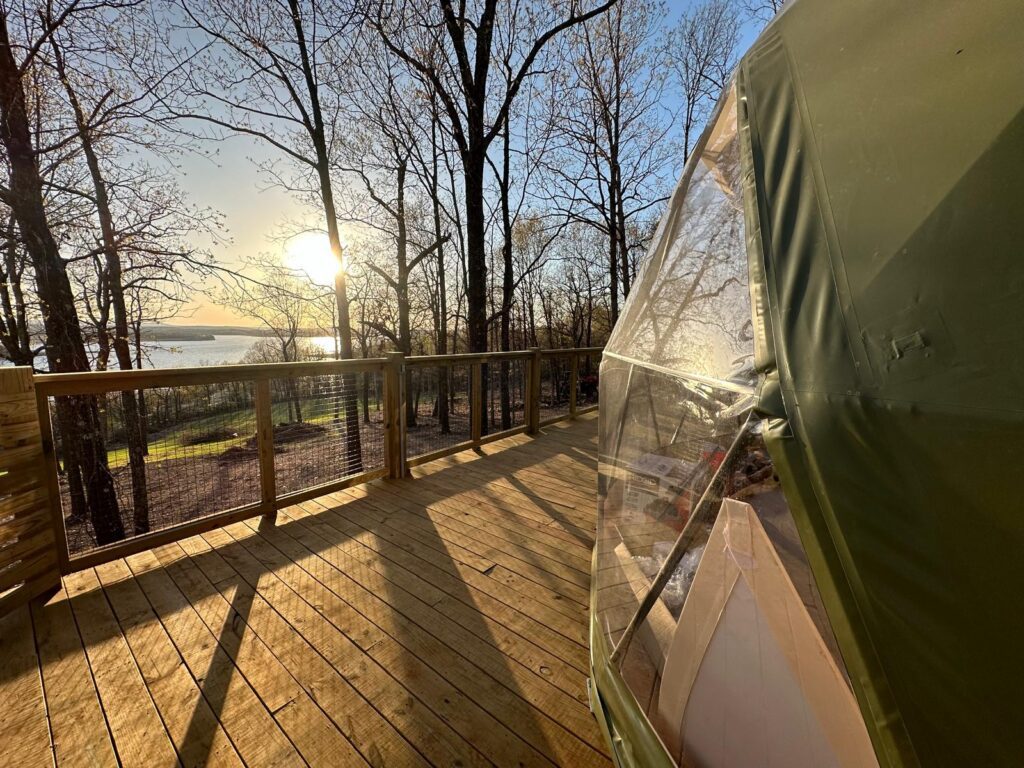
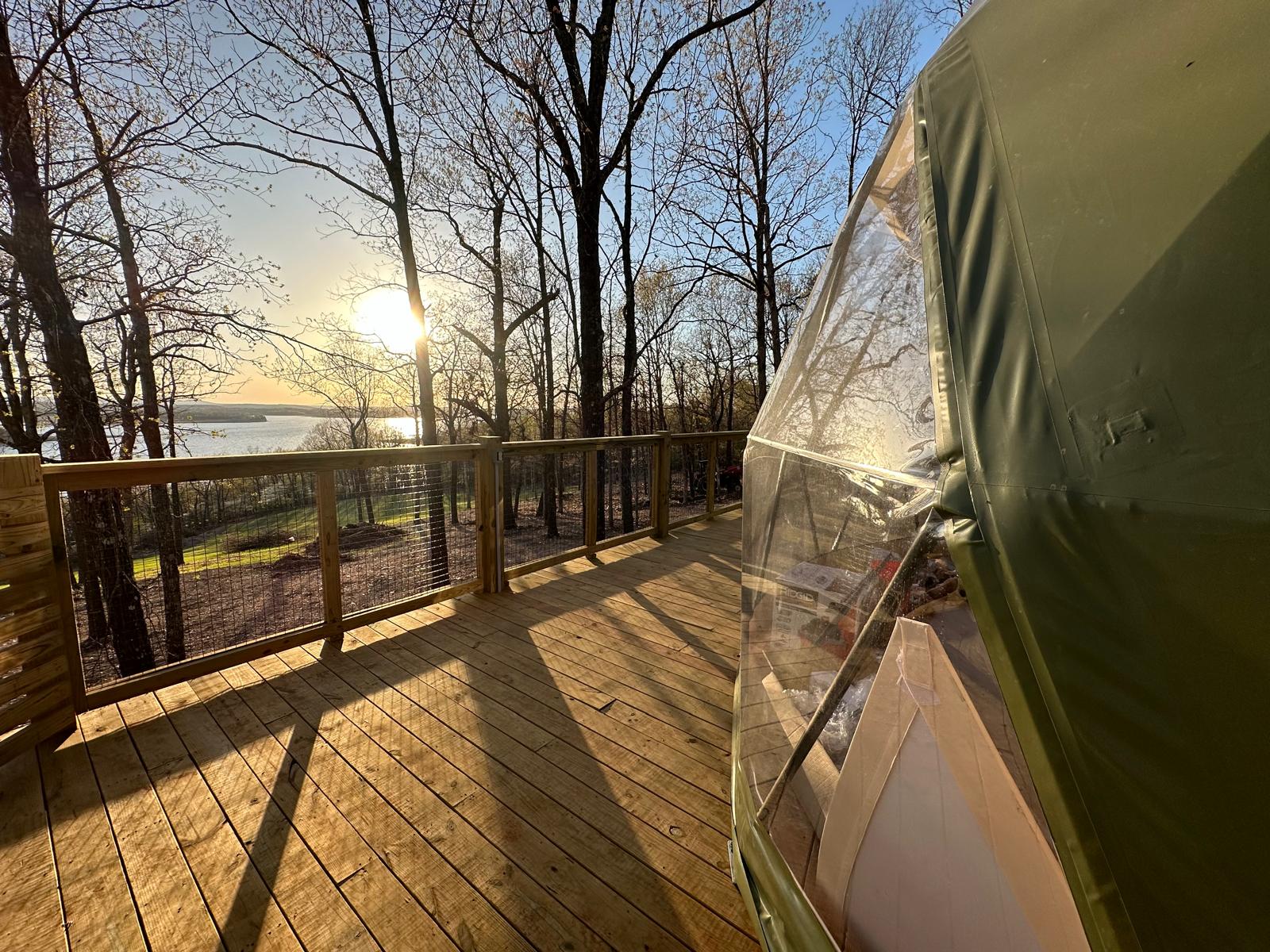
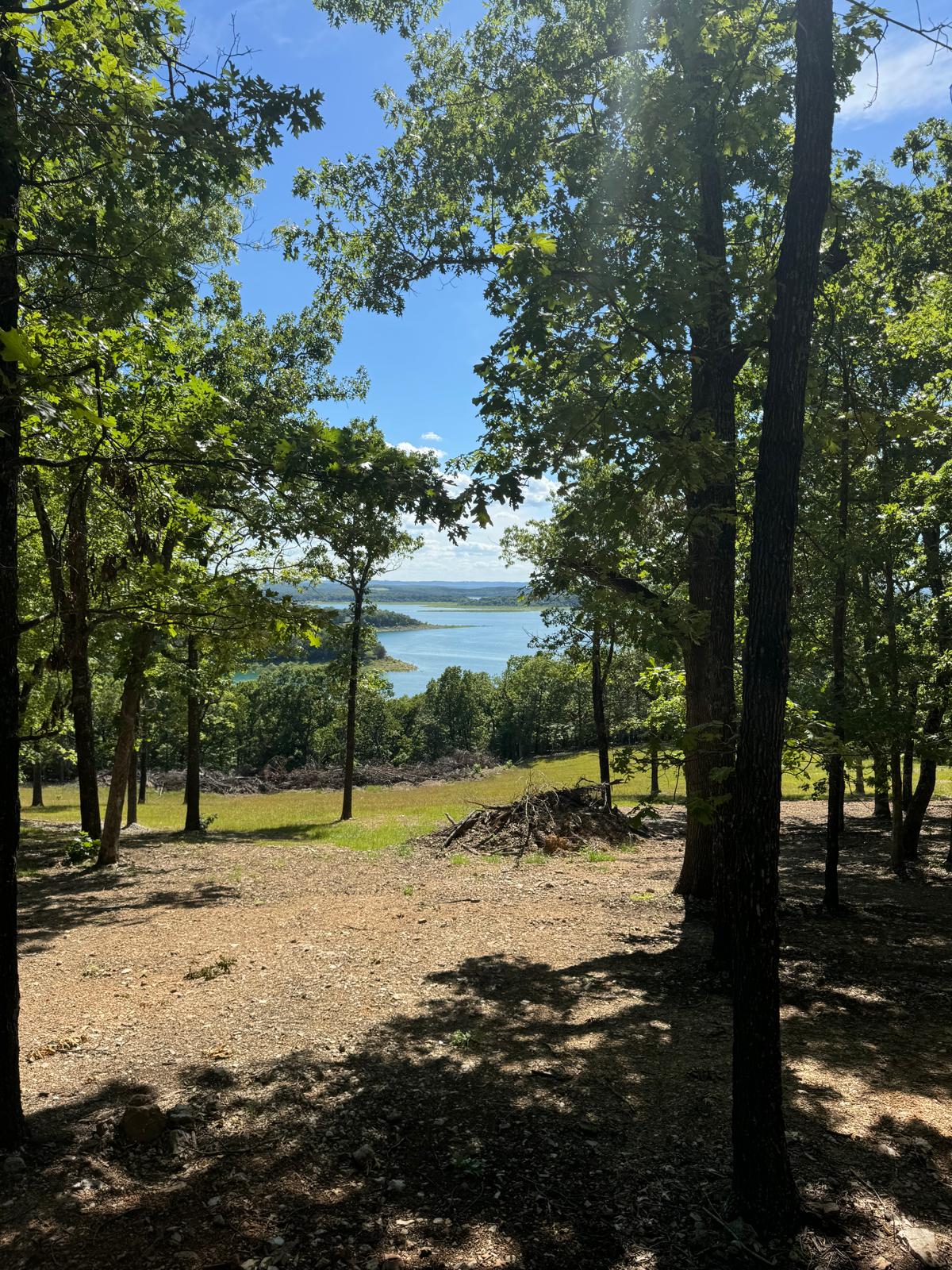
Six geodesic domes on Bull Shoals Lake in the Arkansas Ozarks, sitting in a near-zero light pollution zone. From your private hot tub on a clear moonless night, you’ll see the Milky Way the way you remember it from childhood — assuming you grew up rural. If you grew up suburban or urban, you’ve never actually seen it.
Why Bull Shoals is a real dark-sky destination
Most “dark sky” marketing is loose talk. Bull Shoals area earns it.
- Distance from major cities. The closest city of any size is Springfield MO (1.5 hours northwest). Memphis is 5 hours. Little Rock is 3 hours. There’s nothing big enough in any direction to throw a glow on the horizon.
- Population density of the surrounding counties. Marion County, Arkansas — where Falling Stars sits — has fewer than 20 people per square mile. Compare to suburban Atlanta (3,000+) or even rural Tennessee (~150). The ground is dark because nobody lives on it.
- Bortle scale Class 2-3. The Bortle scale rates night sky darkness from Class 1 (perfect natural sky, found only in places like remote deserts) to Class 9 (inner city). Bull Shoals area is Class 2-3 — meaning the Milky Way is bright, distinct, and shows structural detail. Most Americans live in Class 5-8 areas where the Milky Way is invisible.
- Geography helps. The Ozark hills around the property block residual light from any direction. You’re not just in a dark zone — you’re sheltered inside it.
What you can actually see from the dome
From the hot tub on a clear moonless night, with eyes adapted to dark for 20+ minutes, here’s what you can pull out of the sky:
The Milky Way galactic core. From late April through early October, the bright center of our own galaxy is visible — a thick dappled band stretching across the sky with visible dust lanes and dark patches. This is what people mean when they say they “saw the Milky Way.” Most Americans haven’t.
Individual constellations in full detail. Not just the easy 4-5 brightest stars per constellation, but the dimmer ones that make the picture make sense. Orion in winter, Cygnus and Scorpius in summer, Cassiopeia year-round.
Planets. Saturn, Jupiter, Mars, and Venus when they’re up — brighter and more steady than any star, easy to identify with a phone app.
Meteors during major showers. Perseid meteor shower (peak around August 12), Geminids (December 13-14), Orionids (October 21-22), Leonids (November 17-18), Lyrids (April 22-23), Eta Aquariids (May 5-6). On a peak night you can see 60-100 meteors per hour from a true dark sky site like this one.
Satellites. The International Space Station crosses overhead a few minutes after sunset and before sunrise on most clear nights. Starlink satellite trains are increasingly common — sometimes dozens in a row, slowly fading as they spread out.
The Andromeda Galaxy. With eyes adapted to dark, the closest large galaxy to ours (2.5 million light years away) is visible as a small fuzzy patch near the constellation Cassiopeia. It’s the most distant thing you can see with the naked eye.
Best months and moon phases for stargazing
For the Milky Way galactic core: late April through early October, on nights within a few days of the new moon. (The full moon washes out faint sky features even at the darkest site.)
For peak meteor activity:
- Quadrantids: January 3-4 (winter cold, fewer meteors per hour but very dark sky)
- Lyrids: April 22-23 (moderate; spring weather)
- Eta Aquariids: May 5-6 (good but radiant is low in northern sky)
- Perseids: August 11-13 (the famous one; warm nights, ~60 per hour at peak)
- Orionids: October 21-22 (good; cool fall weather)
- Leonids: November 17-18 (variable; occasional spectacular years)
- Geminids: December 13-14 (often the year’s best shower, ~100 per hour; cold but clear)
For winter constellations (Orion, Sirius, Taurus): December-February. Crisp dry air gives the sharpest views of the year. Cold, but the hot tub helps.
To plan around the moon: Check moon phase before booking. New moon = darkest sky. Full moon = bright enough that even the Milky Way’s central band gets washed out. The week before or after a new moon is the sweet spot.
How to plan a stargazing weekend at Falling Stars
Book within 5 days of a new moon if the sky is your main reason for coming. Otherwise book whenever and the stars are still better than home.
Bring a planetarium app. Sky Guide (iOS), Stellarium (iOS/Android, free), or Star Walk all let you point your phone at the sky and identify what you’re looking at. Set them to “night mode” so the red interface doesn’t ruin your dark-adapted eyes.
Bring binoculars if you want detail. A telescope is optional — most of the best dark-sky views are naked-eye. But 7x or 10x binoculars unlock craters on the moon, Jupiter’s four largest moons, and details in the Andromeda Galaxy and Orion Nebula. You can also rent good binoculars cheaply if you don’t own a pair.
Let your eyes adapt. Full dark adaptation takes about 30 minutes. Don’t look at your phone screen (even on night mode, it sets you back). Bring a red flashlight if you need light for the path — white light wipes out your night vision for 20+ minutes.
Plan for late. The galactic core is highest around midnight in summer, 10pm in early fall, 3am in late spring. Expect to be up late. The hot tub helps.
Check the weather. Even a dark sky is useless if it’s cloudy. Aim for nights with low humidity and high pressure. Spring and fall offer the best combination of clear nights and tolerable temperatures.
Coming to chase dark skies? Pick your starting city
Dark-sky travelers come from everywhere. If your home city is on this list, here’s the drive:
- Branson, MO — 2 hours south
- Eureka Springs / NW Arkansas — 2 hours east
- Little Rock, AR — 3 hours north
- Tulsa, OK — 5 hours east
- Memphis, TN — 5 hours northwest
- Kansas City, MO — 5 hours south
- St. Louis, MO — 5 hours southwest
- Oklahoma City, OK — 5.5 hours east
- Wichita, KS — 5.5 hours southeast
- Dallas / Fort Worth, TX — 6 hours north
Frequently asked questions
How dark is it really? Like, can I see the Milky Way clearly?
Yes. The Bull Shoals area is Bortle Class 2-3 — meaning the Milky Way isn’t just visible, it shows structural detail (dark dust lanes within the bright band). Most Americans live in Class 5-8 areas where the Milky Way is partially or completely invisible. If you’ve only seen the Milky Way in photos, this is different.
Do I need a telescope?
No. Most of the best dark-sky views are naked-eye — the Milky Way, constellations, meteor showers, the Andromeda Galaxy. Binoculars (7x or 10x) add a lot for moon craters, Jupiter’s moons, and nebula detail. Telescopes are optional.
What’s the best time of year?
April through October for the Milky Way galactic core. Year-round for general stargazing. Plan around the new moon for best results — even a half moon noticeably washes out the dimmer features.
Can I see meteor showers?
Yes — most of the major annual ones are dramatically better from a dark sky site. Perseids (August 11-13) and Geminids (December 13-14) are the year’s two biggest. On a peak night you can see 60-100 meteors per hour.
What about light pollution from the property itself?
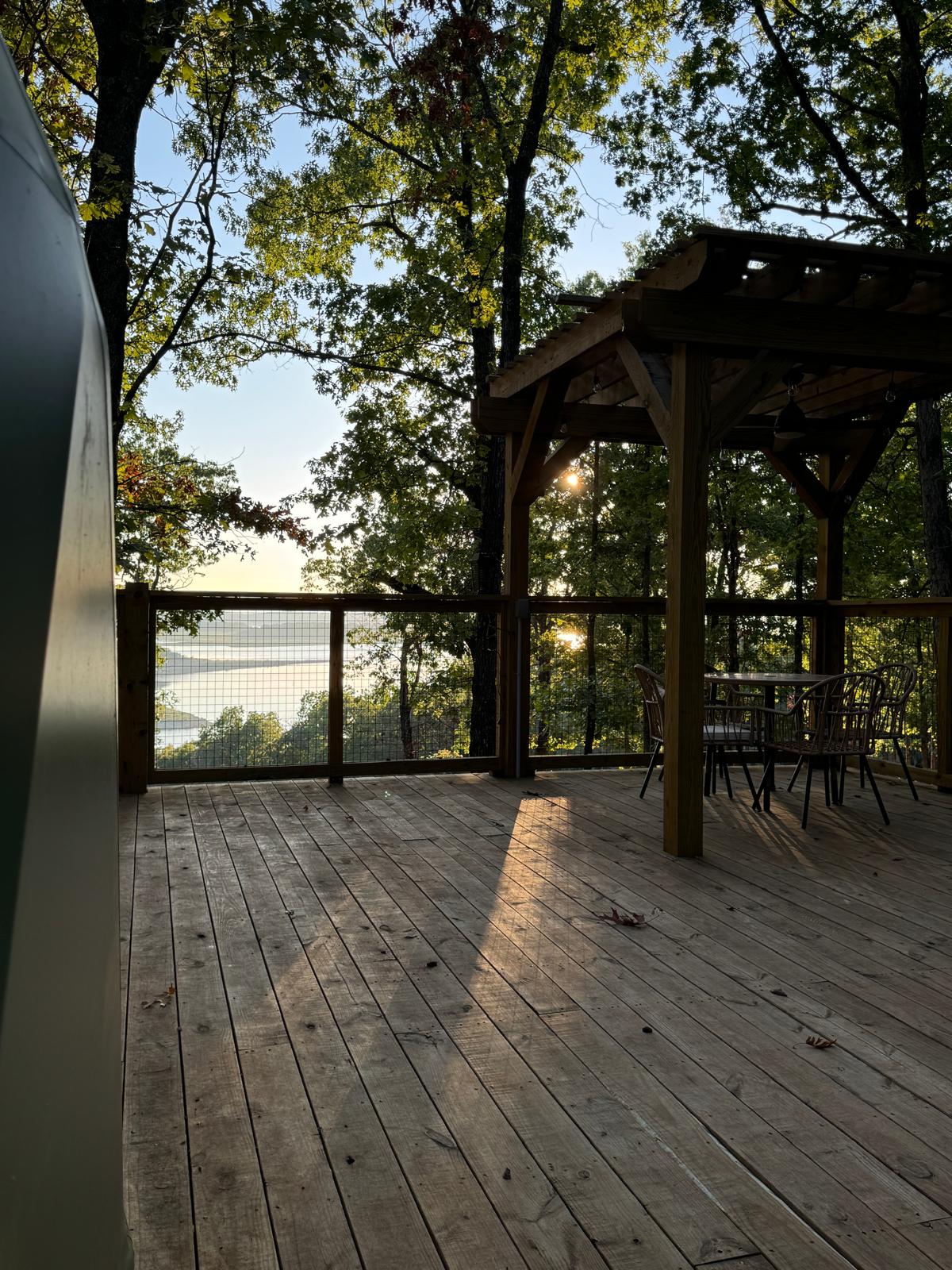
Minimal. Outdoor lighting on the property is intentionally low (no flood lights or all-night security lights) and the domes are spaced so light from one doesn’t bleed into another’s deck view. Each dome’s hot tub deck has a clear view of a large portion of sky.
What if it’s cloudy?
It happens — there’s no controlling the weather. The property has plenty to do otherwise: lake, fishing, hot tubs, hiking. But if dark skies are the primary reason for your trip, check the forecast a week out and don’t book a moonless weekend that’s also going to be overcast. The Bull Shoals area tends to have its clearest skies in late summer through early fall (August-October), with crisp dry winter nights as the runner-up.
Are kids into this?
Kids who’ve never seen the Milky Way are usually amazed by it. Younger kids may not stay up late enough for prime viewing — but meteor showers and bright planets are visible earlier in the evening.
What apps do you recommend?
Sky Guide (iOS, ~$3) and Stellarium (iOS/Android, free) are the two most accurate sky-pointer apps. Both have a “night mode” red interface that won’t kill your dark adaptation. For meteor shower predictions specifically, Heavens-Above.com is a longtime favorite.
Plan your dark-sky weekend at Falling Stars
Six geodesic domes, private hot tubs on every deck, and one of the cleanest skies in the central US. Book around a new moon, bring an app, look up.